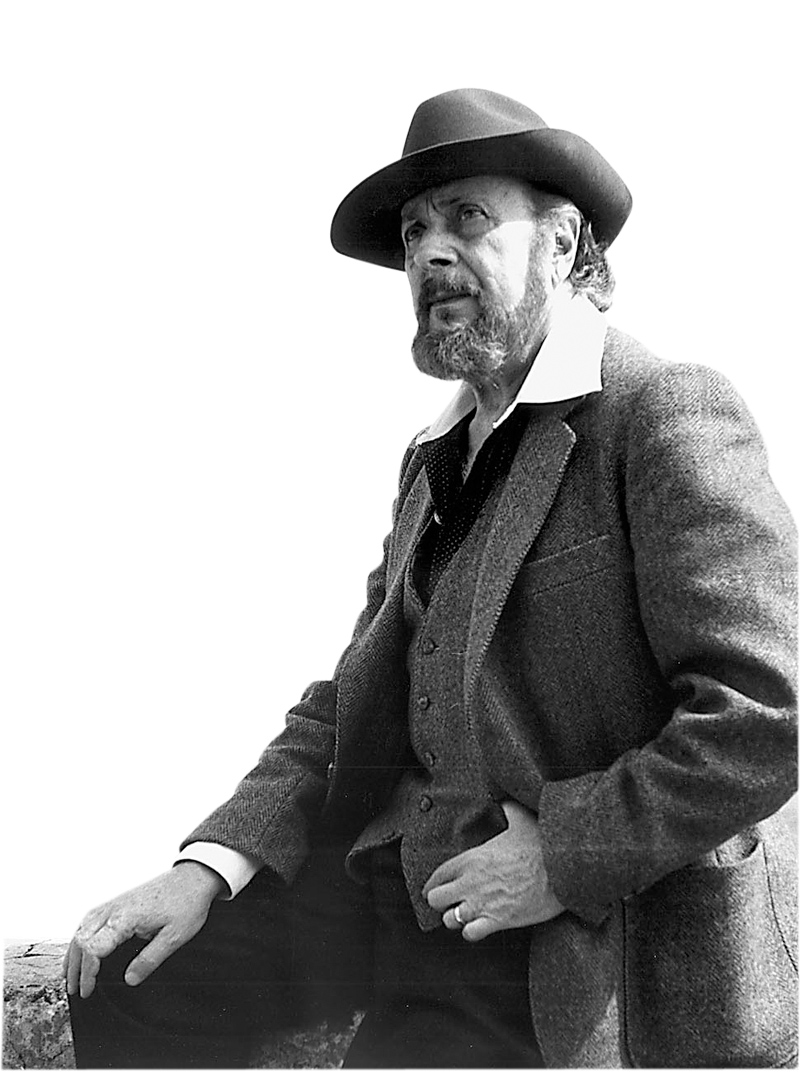


Yannis Ritsos is one of Greece’s leading poets, the poet of Romiosini, as he has been described. His work consists of one hundred poetry collections and compositions, nine novels, four plays, and studies. Foreign editions of his work, which have been translated into forty different languages, number 266.
Yannis Ritsos was born on May 1, 1909, in Monemvasia. He was the last child of the Ritsos family. His father, Eleftherios, was born in 1872 and was of Cretan descent. Eleftherios Ritsos was the heir to a huge estate and a royalist. He associated with the clergy and had limited knowledge, having only completed elementary school. Ritsos’ mother was Eleftheria Vouzounara, born in 1879, the daughter of wealthy merchants from Gythio. The two married when she was only 13 years old, and it was agreed that they would live together permanently once she finished high school.
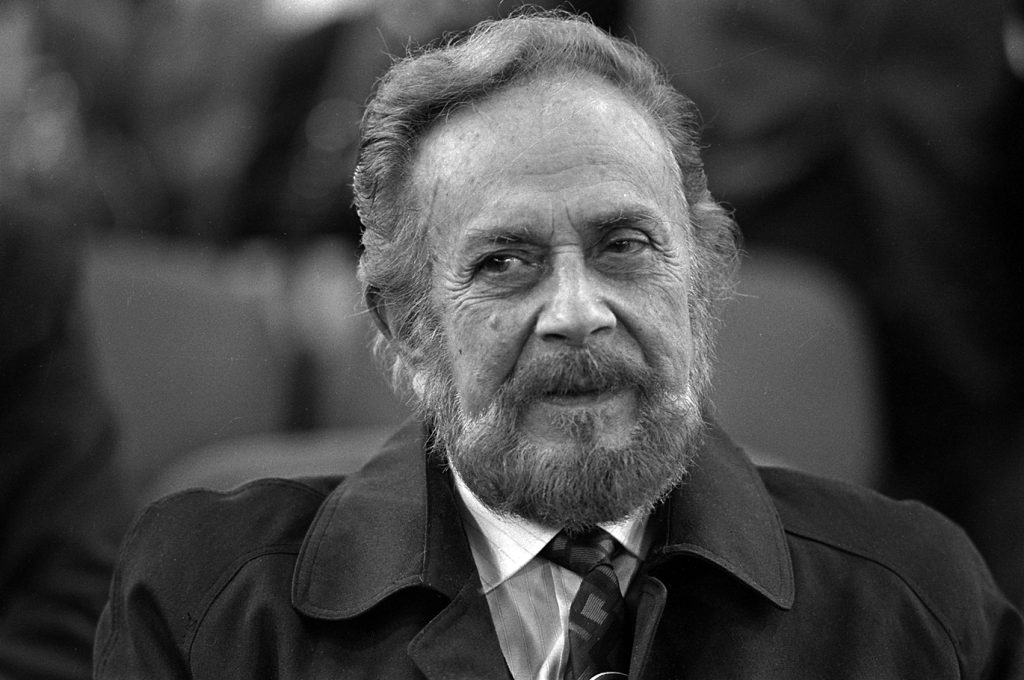
The family lived opposite Panagia Chrysafitissa. Later, after the birth of Yannis, they settled permanently in a house that Eleftherios bought at the entrance to the castle town, next to the walls, a house that has been restored and survives to this day.
Ritsos’ childhood in Monemvasia was carefree, and he spent his early years close to nature. Some problems he had with his eyesight in childhood, perhaps due to cataracts, frightened him. The fear of losing his sight accompanied him until adulthood. His mother, who was well-educated, showed him a lot of love and tenderness.
“This people kneels only before its dead.”
His grandmother Anna told him fairy tales, as did a Moraitis, who took care of him and Loula after their grandfather was murdered in 1910. From an early age, Ritsos showed an aptitude for the arts, as he quickly began painting and learning the piano, while, as he himself testifies, he was writing lyrics from the age of 7. His mother fully supported him in this inclination and believed that one day he would succeed Kostis Palamas. Later, she subscribed him to the magazine Diaplasis ton Paidon (The Education of Children).
 Ritsos completed his first 14 poems, which were published by Laiko Vivliopoleio in 10,000 copies (a record number). Almost all of them were sold, except for 250, which were burned at the Columns of Olympian Zeus after the establishment of the dictatorship by Ioannis Metaxas on August 4, 1936. This poem became one of Yannis Ritsos’s best-known poems among the Greek public. After this incident, Ritsos continued to write for the sporadic illegal editions of Rizospastis under the pseudonym SOSTIR (an anagram of RITSOS).
On October 15, 1936, Ritsos became a member of the Greek Actors’ Union. The performances he gave as a dancer and actor (which did not make him particularly proud) took such a toll on him that his health deteriorated. This time, from October 1937 to April 1938, he lived at the Parnitha Sanatorium, where he wrote A Firefly Lights Up the Night and Spring Symphony, thanks to his unprecedented love. The misfortunes for both the family and himself continued when his sister Loula visited their sister on February 9, 1937, and told her that she had seen God. She then went to Daphni, where her father was, and on November 5, 1938, she saw her father’s body being taken out of the room opposite. Ritsos was inspired by his sister’s experiences and wrote the poem Song of My Sister, for which Kostis Palamas wrote at the end of the quatrain: “Let us step aside, poet, so you may pass.”
“And words are veins. Blood flows through them.”
It was then that he used the pseudonym Kostas Eleftheriou for the first time, signing three poems that he published in Nea Grammata. That same year, he wrote “Epitaph,” one of his most famous works.
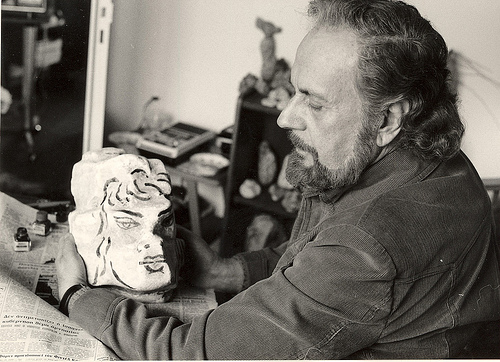 At the same time, he participated in performances at the National Theater and the Greek National Opera. In 1942, he joined the educational wing of the EAM. During the December riots, his archive was destroyed. In 1945, he began writing Romiosini. In 1948, he was arrested and imprisoned on Lemnos. In 1949, he was transferred to Makronissos. In addition to the poems he wrote during his exile, he also turned to painting. With the help of his comrades, some of his works from this period have been preserved, a typical example being his manuscripts, which Manos Katrakis had buried.
In 1950, his health deteriorated, and although he was released, a month later he was arrested again and transferred to Ai-Stratis. He finally returned from exile to Athens in 1952, carrying all his poems and paintings in two suitcases with double bottoms. In April 1954, “Agrypnia” was published. It contains Romiosini and Kyra ton Ampelion.
In 1966, Romiosini was separated from Agrypnia and published for the first time as a separate edition. Mikis Theodorakis set some of its excerpts to music, and on the album released that same year, the lyrics were performed by Grigoris Bithikotsis.In 1967, after the coup d’état of April 21, he was arrested and exiled to Gyaros and then to Leros. In 1968, his diagnosis with cancer led him to destroy some of his unfinished works, believing that he would not have time to complete them.
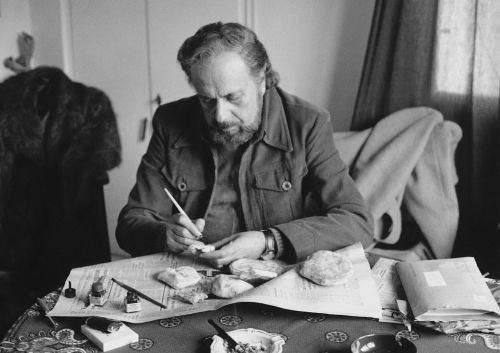
The years that followed until his death were rich in literary work, but also in political action.
He died on this day, November 11, 1990, and was laid to rest in Monemvasia.
“Do not mourn Romiosini, ―where it is about to bow down, with the knife at its bone, with the strap at its neck, Behold, it leaps from the beginning and manhood and rages and harpoons the beast with the harpoon of the sun.”
AWARDS
In 1956, he was awarded the First State Prize for Poetry for his “Moonlight Sonata.” In 1972, he was awarded the Grand International Prize for Poetry in Belgium. Three years later, in 1975, he received the Georgi Dimitrov International Prize in Bulgaria and was also awarded an honorary doctorate from the University of Thessaloniki. That same year, he was awarded the Grand Prix de Poésie Alfred de Vigny in France and was nominated for the Nobel Prize. In 1976, he received the International Aetna-Taormina Prize. In 1977, he was awarded the Lenin Peace Prize and in 1978 the International Bodello Prize. That same year, he was awarded an honorary doctorate from the University of Birmingham. In 1986, he was awarded the UN’s “Poet of International Peace” prize and a medal from the French National Mint. In March 1987, he was awarded an honorary doctorate from the Faculty of Philosophy of the University of Athens, and the Mayor of Athens awarded him the city’s Gold Medal of Honor. In 1990, he was awarded the “Zolio-Curie” medal, the highest distinction of the World Peace Council.